Vietnam – Green Finance Skills

Summary
The Vietnam Green Finance TVET Skills Project is a major UK–Vietnam collaboration addressing critical skills gaps in green finance, ESG implementation, and sustainable investment. Funded by the British Embassy in Vietnam and delivered by Skills for Inclusion Ltd, the project engaged over 400 stakeholders across government, finance, education, and industry. Using an employer‑led, co‑creation approach, it partnered with City St George’s, University of London to develop two industry‑validated micro‑credentials focused on applied green finance and ESG integration. Multi‑city engagement ensured strong policy alignment and practical relevance, establishing clear demand, early impact, and a pathway for national scale‑up.




Vietnam’s financial sector is undergoing a rapid transformation as the country advances its climate commitments and financial‑sector reforms, creating an urgent need for a workforce equipped with practical skills in green finance, ESG reporting, and sustainable investment. Financial institutions highlighted significant capability gaps, particularly in ESG reporting, taxonomy implementation, and carbon‑market mechanisms. These gaps emerged at a time when national policy ambitions for sustainability and green growth were accelerating, yet training provision across universities, TVET providers, and industry did not fully match the sophistication or immediacy of industry needs.
To understand and address this challenge comprehensively, the project brought together a large and diverse network of stakeholders, engaging more than 400 participants from government ministries and regulators, commercial banks, investment professionals, universities, TVET institutions, and sustainability specialists. Engagement was conducted across three major cities, Hanoi, Ho Chi Minh City, and Da Nang, each playing a unique role in shaping the diagnostic process.
Hanoi enabled national‑level policy dialogue and regulatory insight, Ho Chi Minh City provided direct access to industry perspectives and financial‑sector practice, and Da Nang facilitated discussions on training delivery models and regional needs. This geographic and institutional breadth revealed challenges not only in technical capability but also in the alignment between policy objectives, employer expectations, and the existing skills system. Employers reported that existing training options were often theoretical, insufficiently applied, and not structured to meet immediate operational demands in green finance.
This convergence of policy ambition, industry expectation, and skills‑system limitations created a clear challenge: how to rapidly build a workforce capable of implementing green finance and ESG frameworks in practice, while ensuring national alignment and employer relevance.
Solution
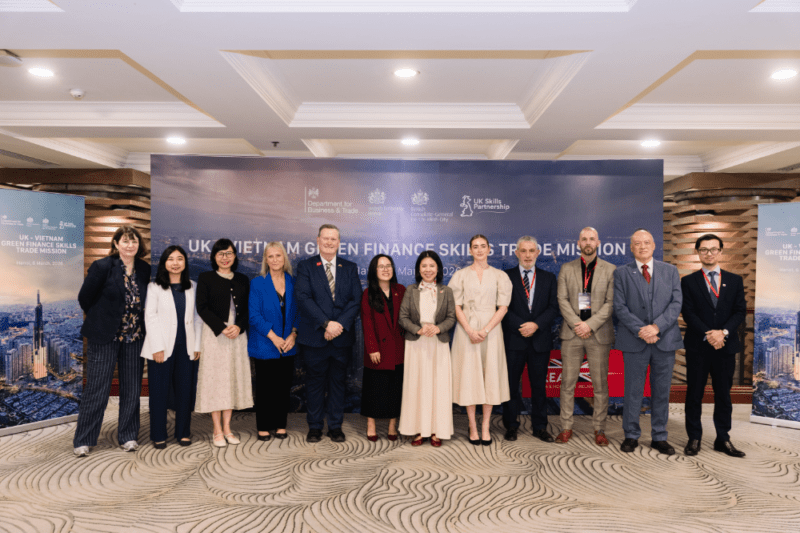
Against this backdrop, the project created a structured opportunity to design coordinated, employer‑led solutions capable of addressing Vietnam’s emerging green‑finance capability requirements. Delivered as part of the UK Green Finance Trade Mission led by the Department for Business and Trade (DBT), the initiative brought together a consortium of UK and Vietnamese partners to align government priorities, industry needs, and training provision. Skills for Inclusion Ltd served as the programme lead, working alongside City St George’s, University of London, UK chartered institutes, awarding bodies, and a wide range of universities, financial institutions, and sustainability experts in Vietnam. These partnerships enabled an employer‑led co‑design process that positioned industry as central to determining training content, structure, and competencies.
Employers, including commercial banks, investment professionals, and ESG specialists, actively contributed to defining the technical requirements for those working in green finance, ensuring that solutions reflected real‑world financial decision‑making, immediate implementation needs, and emerging regulatory requirements.
This collaborative approach supported the co‑creation of two flagship micro‑credentials with City St George’s: Applied Green Finance: Project Appraisal and Taxonomy Implementation and ESG Integration, Reporting and Assurance (including ETS/MRV). Both programmes were deliberately designed to be practical, modular, and aligned with leading international frameworks such as ISSB, the GHG Protocol, and ICMA standards.
Multi‑city workshops reinforced this design approach by enabling national policy alignment in Hanoi, industry validation in Ho Chi Minh City, and delivery‑model testing in Da Nang, ensuring the training solutions were relevant and scalable across different regions of Vietnam. Through this process, the project established a clear pathway for employer‑aligned, system‑ready training solutions that respond directly to Vietnam’s green finance skills challenge.
Impact
The project delivered a set of strong, measurable outcomes that addressed Vietnam’s immediate need for practical green‑finance capability development. Through extensive engagement with more than 400 stakeholders across government, financial institutions, universities, industry, and TVET providers, the project successfully validated national workforce priorities and skills gaps.
A key achievement was the co‑creation of two industry‑endorsed micro‑credentials, Applied Green Finance: Project Appraisal and Taxonomy Implementation and ESG Integration, Reporting and Assurance (including ETS/MRV), which were designed to be practical, modular, and fully aligned with international frameworks. These programmes were developed collaboratively with employers to ensure they respond to real‑world financial decision‑making and regulatory requirements. In addition, the project produced a fully defined pilot‑ready programme design, offering clear pathways for adoption by universities, training providers, and industry stakeholders.
The project also strengthened partnerships between UK institutions and Vietnamese organisations, positioning the UK as a trusted collaborator in Vietnam’s sustainable‑finance skills development landscape.
The project has already demonstrated strong early influence across Vietnam’s green‑finance ecosystem. Employers signalled clear and urgent demand for practical implementation skills in taxonomy application, ESG reporting, and carbon markets, affirming that the project’s training focus directly aligns with their priority capability needs. Stakeholders also endorsed the shift toward short, targeted, employer‑led micro‑credentials and case‑based learning, reflecting a broader transition within Vietnam toward applied, industry‑relevant training models.
The project contributed to national‑level discussions on green‑finance capacity development and supported alignment with wider climate, ESG, and financial‑sector reforms. A clear pipeline for scale has already been established, with next steps including pilot delivery of the micro‑credentials, expansion across more financial institutions and regions, and integration into Vietnam’s wider TVET and higher‑education systems. These stages create a pathway for long‑term workforce transformation and sustained capability development.
Read more about Skills For Inclusion Limited’s work:
https://skillsforinclusion.co.uk/
Read more about City St George’s University of London: