Malawi – TVET Female Leadership Programme

Summary
South Eastern Regional College led an International Skills Partnership in Malawi in collaboration with the Ministry of Labour, Soche Technical College, Mzuzu Technical College, Lilongwe Technical College, Nasawa Technical College and Ezondweni Community Technical College. The project was funded through the British Council’s Going Global Partnerships programme and focused on strengthening female leadership within Malawi’s TVET sector.
Although there are national ambitions to increase female participation, women remain underrepresented at senior leadership level across the education sector, particularly within the technical trades such as construction, engineering and ICT, fields dominated by men. Also, female students face a range of physical barriers, inequitable gender attitudes, restrictive cultural gender norms and stereotypes that continue to affect access and outcomes for women in TVET, their success in TVET training and employment in TVET-related jobs.
Between 2013 and 2018, women accounted for less than 35% of TVET students. Current national policies aim to raise this to 40%. However, the number of women in influential, decision-making roles in TVET and those with capacity to drive and promote change in TVET remains low.




Challenge
Malawi’s TVET sector is central to economic growth and youth employment, yet women continue to face barriers both as learners and as leaders. While policy aims to increase female participation, women remain underrepresented in technical trades and even more so in senior leadership roles. Student barriers include limited progression pathways, lack of mentoring, low visibility of female role models, inequitable gender attitudes and cultural expectations around women’s roles. Further, most TVET training programmes tend to be in construction, engineering, and ICT, fields traditionally dominated by men. Between 2013 and 2018, women accounted for less than 35% of TVET students. Current national policies aim to raise this to 40%. However, the number of women in influential, decision-making roles in TVET and those with capacity to drive and promote change in TVET remains low.
The Ministry of Labour identified that strengthening female leadership capacity could be a practical way to influence change from within the system. Rather than focusing only on student access, the opportunity was to support women already in leadership positions to build their confidence, strategic thinking and ability to influence institutional practice. The plan was for SERC to collaborate with the Ministry of Labour and the TVET Authority to develop and deliver a leadership development programme for 15 women holding leadership positions in the TVET sector. The cohort of 15 women was to extend to government officials, instructors, managers and college Principals. The agreed plan was to design and deliver a targeted Leadership Development Programme for female leaders across the TVET system. The programme included an initial skills audit, structured leadership sessions, mentoring support and the development of applied leadership projects that addressed real institutional challenges.
The leadership programme was designed to build personal effectiveness, to enhance communication skills and decision making, while focusing on interpersonal excellence to develop relationship building and resilience, enabling clear purpose and direction. Indeed, the intention was not simply to deliver training, but to create sustainable transformational change through empowered female leaders working within their own colleges and networks.
SERC’s approach was to support the development of strategic female leadership skills to deliver the transformational change required to drive positive change in the Malawi TVET sector. Project methodology embraced the transformational changes needed to enable senior female TVET leaders to effectively drive the skills agenda and build the capacity of young people to deliver economic and societal change.
SERC has extensive experience in working with strategic leaders across a wide range of sectors including bespoke Women in Leadership programmes, delivered face to face or using virtual learning environments. SERC’s bespoke programmes have developed critical strategic leadership skills and behaviours on behalf of local government bodies to support local businesses, particularly female leadership development and capacity.
Solution
SERC worked in collaboration with the Ministry of Labour and the TVET Authority to design and deliver a Leadership Development Programme tailored to senior female leaders working across Malawi’s TVET sector. A Training Needs Analysis was completed to identify leadership development priorities and shape the content accordingly.
The programme included:
- 11 online leadership workshops
- One-to-one mentoring
- Peer networking and group discussion
- Development of an applied leadership project
- An inbound visit to Northern Ireland
- A final outbound visit to Malawi – graduation ceremony
Sessions covered strategic leadership, change management, stakeholder engagement, governance, leadership styles, enterprise and innovation, mentoring for leadership projects and personal development planning. Reflective practice and peer-to-peer support was embedded throughout to ensure learning objectives were met and encourage group networking. Each participant developed a leadership project focused on a real leadership challenge within their institution to help embed their learning. These projects included: increasing female enrolment in male-dominated trades; improving retention of female students; establish a networking framework with successful female entrepreneurs to inspire final year female students; and strengthening mentoring support structures. The inbound visit to SERC provided exposure to leadership practice, governance structures and inclusive approaches within a UK further education context. The outbound visit supported final project presentations, assessment and stakeholder engagement with Ministry representatives and senior college leaders and incorporated a Graduation ceremony to recognise participant achievements. All participants received a Certificate of Completion and two attained the Chartered Management Institute Level 5 Award in Leadership and Management.
Following the success of this project, SERC was awarded an extension project to focus on embedding the leadership projects within the participant institutions. Mentoring and coaching sessions helped participants to realise their projects and build their confidence through evidence-based decision making and adoption of entrepreneurial outcome-based approaches. Sustainability was achieved through the delivery of a supplementary leadership development programme to build sufficient participant confidence to consider promotional opportunities eventually leading to a more equitable gender based TVET sector. This was underpinned by a sel-learning Leadership Toolkit providing participants with further information regarding personal development and key skills including building influence with decision makers, targeted policy engagement and persuasion among key stakeholders to create conditions for women’s rise into leadership and impact.
The programme has evidently delivered impact and long-term benefits at individual, institutional and wider sector level. All participants successfully completed the programme and implemented their leadership projects within their institutions. Participant feedback cited increased confidence, capacity for effective decision-making and stronger leadership awareness, empowering them to begin influencing societal change. While most participants reported feeling more prepared to take on leadership responsibilities and influence change within their institutions.
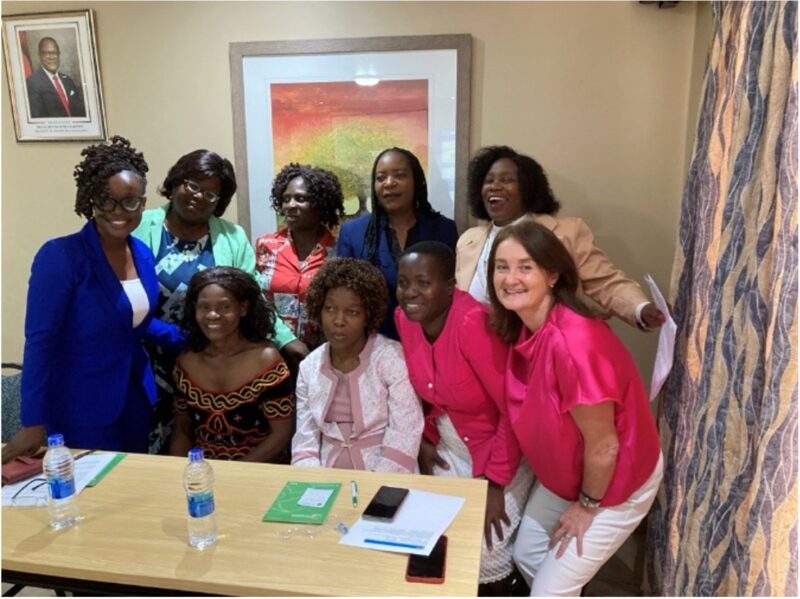
At institutional level, each participant developed and presented a leadership project tailored to her own college or department. These projects focused on improving female participation, strengthening mentoring structures and promoting more inclusive leadership cultures. Indeed, project recommendations have already begun to inform internal practice, particularly around recruitment, support and progression for female staff and students. Pamela Chriwa, Mzuzu Technical College has reported an increase in female student numbers on the automobile mechanics courses due to her increased confidence and the implementation of her project to create a more inclusive and supportive environment for female students to pursue their interest in automobile mechanics. Chifundo Lodzeni, Ministry of Labour was promoted to the position of Senior Deputy Director for Community Technical Colleges when she indicated in her Curriculum Vitae that she was coordinating training and participating in this Strategic Female Leadership in TVET training programme.
At a wider level, the programme contributed to the development of a network of female leaders from the private and public sectors across Malawi’s TVET sector. Participants expressed a strong commitment to continuing collaboration through the establishment of a Female Leaders’ Forum, creating a platform for peer support, knowledge sharing and collective advocacy around gender equity in leadership.
The Graduation Ceremony in October 2024 brought together Ministry officials, British Council representatives, high-profile female leaders from the private sector and senior college leaders, increasing visibility of female leadership within the sector and reinforcing institutional support for continued progress.
During the extension phase, participants moved from project design into implementation, introducing mentoring platforms, supporting female retention in technical trades and strengthening links between female students and industry role models. Two participants, noted above, completed the internationally recognised Chartered Management Institute Level 5 Award in Leadership and Management and have already benefitted from participation in the leadership programme. A supplementary self-learning Leadership Toolkit is being implemented within the institutions providing a structured framework of support that is being used to provide mentoring and coaching support for future female leaders, ensuring sustainability beyond the original cohort.
Whilst this project has already demonstrated clear impact, in the longer term, strengthening female leadership within TVET institutions will contribute to improved governance, more inclusive environments and greater encouragement for female students to progress in technical fields.
Read more about SERC’s work:
https://www.serc.ac.uk/News/Article/SERC-Malawi-Partnership-Highly-Commended-